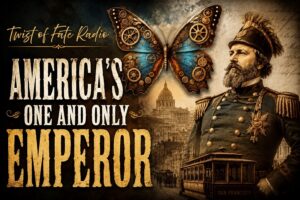
 America’s One and Only Emperor
In 1859, a man walked into a San Francisco newspaper office and made one of the boldest announcements in American history.
He had no army.
No crown.
No election.
No palace.
No government behind him.
But he had a title.
He declared himself Emperor of the United States.
On paper, it should have been the end of the story — a strange notice printed in a local newspaper, laughed at for a day or two, then forgotten. But that is not what happened.
Instead, San Francisco did something unexpected.
The city played along.
Restaurants fed him. Police officers saluted him. Newspapers published his proclamations. Theater owners gave him seats. Shopkeepers accepted his handmade currency. And over time, the man who had lost almost everything became one of the most beloved figures in San Francisco history.
His name was Joshua Abraham Norton.
But history remembers him as Emperor Norton.
A Fortune Built in a Booming City
Before he became a legend, Joshua Norton was a businessman.
He was born in England, likely in 1818, and raised in South Africa after his family moved there when he was young. Like many ambitious men of his era, Norton eventually made his way to America during the years of opportunity surrounding the California Gold Rush. He arrived in San Francisco in 1849, a time when the city was changing at breathtaking speed.
San Francisco was no ordinary place in the 1850s. Gold had transformed it almost overnight. Ships crowded the harbor. Fortunes were made and lost quickly. Merchants, miners, speculators, and dreamers poured into the city, all hoping to grab a piece of the future.
Norton seemed to be one of the men who might actually succeed.
He invested in real estate and commodities, and for a time, he became wealthy. Some accounts describe him as a prosperous businessman and rice trader, respected enough to move in the circles of San Francisco’s rising merchant class.
But in a city built on risk, one bad gamble could undo everything.
The Deal That Destroyed Him
In the early 1850s, Norton made a risky business move involving rice.
A famine in China had interrupted exports, causing rice prices in San Francisco to rise sharply. Norton believed he saw an opportunity. If he could buy up a large incoming shipment, he might control the local market and make a fortune.
So he invested heavily.
But then more rice shipments arrived.
And more.
The scarcity vanished. Prices collapsed. Norton’s plan fell apart.
What followed was a long and painful financial decline. Norton sued, appealed, and fought to recover what he had lost, but the courts ultimately ruled against him. By 1858, he was bankrupt.
For a man who had once been known as a successful businessman, the fall was devastating. Norton disappeared from public life for a time, and many people likely assumed his story was over.
But it was not over.
It was about to become something far stranger — and far more memorable.
The Declaration
On September 17, 1859, several San Francisco newspapers received a proclamation.
It began with the kind of sweeping language usually reserved for kings, presidents, and generals. Joshua Norton announced that, at the request of the people, he was declaring himself “Emperor of these United States.” Later, he would also style himself as “Protector of Mexico.”
It was absurd.
A private citizen had simply announced that he was now the emperor of a nation that did not have one.
But San Francisco was a city that understood reinvention. People arrived there every day hoping to become someone new. So perhaps it is not entirely surprising that the city did not reject him outright.
At first, newspapers printed his proclamations because they were entertaining. Norton issued decrees dissolving Congress, commenting on politics, calling out corruption, and imagining himself as the highest authority in the land.
The joke could have been cruel.
Instead, over time, it became affectionate.
The City That Crowned Him
Norton became a familiar figure on the streets of San Francisco.
He wore a military-style uniform, often described as blue with gold accents, along with a decorated hat. Some accounts say parts of his outfit were given to him by officers at the Presidio. He walked through the city inspecting streets, visiting newspaper offices, attending public events, and making appearances at theaters.
People began treating him as if his title were real — not legally, of course, but socially.
Restaurants let him eat without paying. In return, receiving his “imperial approval” became a badge of honor. Theater owners saved him seats. Police officers reportedly saluted him. Businesses accepted his self-issued currency, or at least humored it, and today surviving pieces of that Norton scrip are valuable collector’s items.
The 1870 United States census even listed Joshua Norton’s occupation as “Emperor,” though it also reflected how people of that era viewed his mental state.
By modern standards, it seems likely that Norton had suffered some kind of psychological break after his financial ruin. But the most remarkable part of his story is not that he declared himself emperor.
It is that the city gave him dignity anyway.
San Francisco could have mocked him. It could have chased him away. It could have treated him as a nuisance.
Instead, the people let him belong.
More Than a Joke
It is easy to remember Emperor Norton as a colorful eccentric, but that misses part of the story.
Some of his proclamations were strange, but others were surprisingly thoughtful. He called for religious tolerance. He criticized political corruption. He expressed concern about social division. He also opposed mob violence at a time when San Francisco was full of deep tensions, including anti-Chinese agitation and unrest.
One of the most famous parts of Norton’s legacy involves something that did not exist during his lifetime: a bridge across San Francisco Bay.
In 1872, Norton issued proclamations calling for a bridge, and in some versions a tunnel, linking San Francisco and Oakland. Decades later, the San Francisco–Oakland Bay Bridge and the Transbay Tube would become real. Norton did not engineer them, of course, and the later projects were not built because of him. But the fact that he imagined such a connection long before it existed helped turn him into a kind of accidental visionary.
At the time, many people probably laughed.
History gave the idea a different ending.
A City’s Strange Kindness
What makes Joshua Norton’s story so moving is not simply that he became famous.
It is how he became famous.
He had been a man of money and status. Then he lost his fortune, his place in society, and perhaps part of his grip on reality. In many cities, that might have been the end of his public life.
But San Francisco gave him a new role.
Not an official one.
Not a practical one.
But a human one.
He became part of the city’s identity. He was a living symbol of San Francisco’s oddness, theatricality, humor, and heart. People knew the emperor was not really an emperor. But they also seemed to understand that pretending cost them very little — and gave him a great deal.
That is the quiet beauty of the story.
Sometimes kindness looks like food.
Sometimes it looks like a seat at the theater.
Sometimes it looks like a salute given to a man who needed to feel seen.
The Death of an Emperor
On January 8, 1880, Emperor Norton collapsed on a San Francisco street while on his way to a lecture. He died before he could be taken to a hospital.
When people looked through his belongings, they did not find hidden wealth. They found the possessions of a poor man.
Initial funeral arrangements were modest, but San Franciscans stepped in. A local business association helped provide a proper casket and a more dignified farewell. Newspaper accounts reported that thousands came to pay their respects. The exact size of the funeral crowd has become part of the legend, with later stories sometimes exaggerating the details, but contemporary reports still show that his death deeply moved the city.
One newspaper headline captured the feeling simply:
“The King is dead.”
Or, in the French phrase used at the time:
“Le Roi Est Mort.”
It was a royal farewell for a man with no throne.
The Twist of Fate
Joshua Norton never ruled a country.
He never commanded an army.
He never signed a law.
He never wore a real crown.
But in a way, he achieved something many rulers never do.
He became beloved.
His reign was imaginary, but the affection people felt for him was real. And that is why his story has lasted for more than a century.
A failed business deal ruined Joshua Norton’s fortune. That loss could have erased him from history. Instead, it pushed him into one of the strangest reinventions America has ever seen.
He declared himself emperor.
And the city around him chose compassion.
That was the twist.
Not that a man proclaimed himself America’s ruler — but that thousands of people decided to let him keep his dignity by treating him as one.
America never had a king.
But for a little while, San Francisco had an emperor.
And his kingdom was built not on power…
but on kindness.
Sources
Encyclopedia Britannica — Joshua Abraham Norton.
The Emperor Norton Trust — The Life & Legend of Emperor Norton.
The Emperor Norton Trust — Bridge Proclamations.
Smithsonian National Portrait Gallery — Joshua A. Norton: His Imperial Majesty.
KQED — “America’s Emperor, San Francisco’s Treasure: Who Was Emperor Norton?”
🔗 Explore more stories at TwistOfFateRadio.com
🎙️ For voiceover work, visit ClarkVOServices.com